WebMCP optimization is becoming essential as businesses adopt AI-powered systems that require seamless communication between websites, applications, databases, and intelligent agents. WebMCP enables websites to connect with the Model Context Protocol, allowing AI tools to access structured information, perform actions, retrieve data, and deliver more accurate results. Organizations implementing WebMCP integration gain stronger automation, improved scalability, and enhanced AI performance across digital environments.
What Is WebMCP? The Web Model Context Protocol
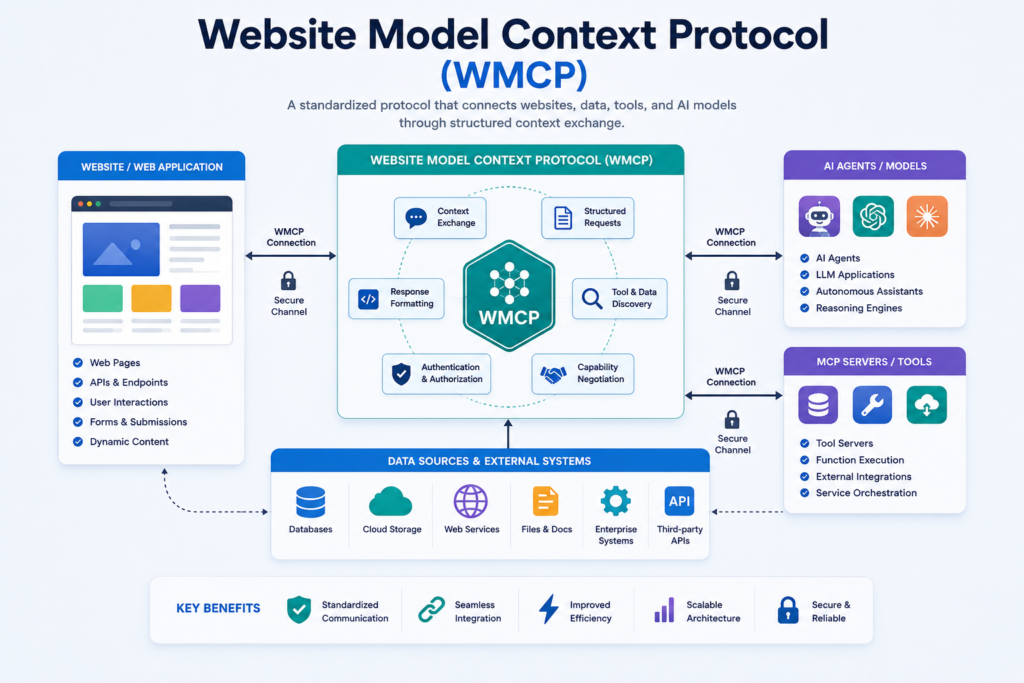
WebMCP (Web Model Context Protocol) is a framework that helps websites, applications, databases, APIs, and digital systems communicate more effectively with AI models and AI agents. It provides a structured way for AI systems to discover resources, access information, perform actions, and maintain context across different platforms. WebMCP is designed to bridge the gap between traditional web technologies and the growing ecosystem of AI-powered applications.
Who Introduced WebMCP?
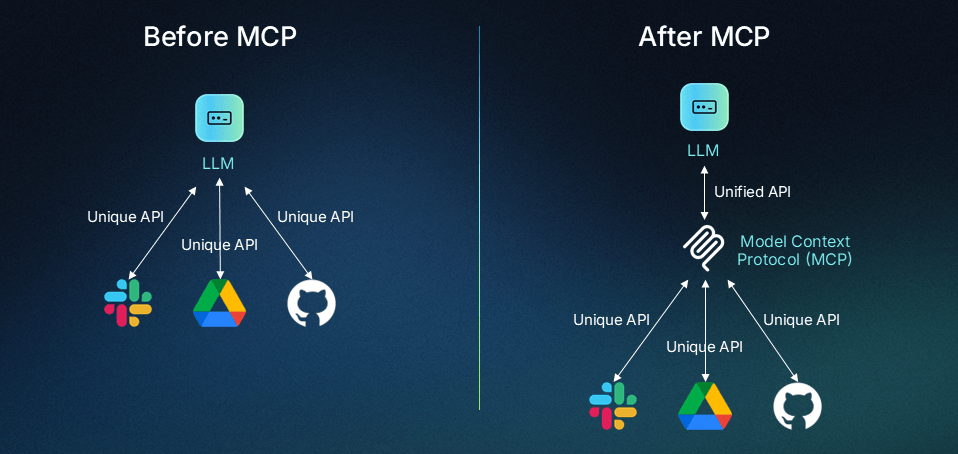
WebMCP is based on the broader concept of the Model Context Protocol (MCP), an open standard developed to solve communication challenges between AI systems and external tools. As AI adoption expanded, developers and technology providers recognized the need for a consistent method that would allow AI models to interact with websites and business systems without requiring custom integrations for every application. WebMCP extends these principles to web-based environments, helping websites become more accessible and useful to AI agents and large language models (LLMs).
Why Was WebMCP Created?
Before WebMCP, AI systems often relied on traditional APIs, web scraping, plugins, and custom integrations to access information. These methods could be complex, difficult to scale, and limited in their ability to provide contextual understanding. WebMCP was introduced to create a standardized communication layer that enables AI systems to interact with web resources in a secure, structured, and efficient way. The goal is to make websites, applications, and enterprise systems easier for AI agents to understand and use.
What Is the Logic Behind WebMCP?
The core logic behind WebMCP is simple: AI systems perform better when they can access structured, reliable, and contextual information directly from trusted sources. Instead of forcing AI agents to guess how a website works or rely on fragmented integrations, WebMCP provides clear instructions, resources, permissions, and communication standards. This allows AI systems to retrieve accurate information, execute tasks, and maintain context throughout user interactions. The result is more intelligent, efficient, and scalable AI communication.
What Is the Purpose of WebMCP?
The purpose of WebMCP is to create a universal bridge between AI systems and digital platforms. It helps organizations make their websites, applications, databases, and services AI-ready while improving automation, search capabilities, and operational efficiency. WebMCP enables businesses to support intelligent assistants, AI agents, workflow automation systems, and future AI technologies without constantly rebuilding integrations.
What Problems Does WebMCP Solve?
WebMCP addresses several challenges that businesses and developers face when integrating AI technologies:
- Complex and costly custom integrations
- Limited communication between AI systems and websites
- Inconsistent access to business data and resources
- Poor contextual understanding during AI interactions
- Difficulties scaling AI-powered applications
- Fragmented workflows across multiple systems
- Limited real-time information access for AI agents
By solving these issues, WebMCP creates a more connected and intelligent digital ecosystem.
How Does WebMCP Help Users?
For users, WebMCP creates faster, smarter, and more accurate digital experiences. AI assistants can retrieve relevant information more efficiently, answer questions with greater accuracy, and complete tasks without requiring users to navigate multiple systems manually. Users benefit from better customer support, personalized recommendations, improved search experiences, and faster access to information. As AI becomes more integrated into daily workflows, WebMCP helps ensure that interactions remain seamless and productive.
How Does WebMCP Help AI Agents?
WebMCP is highly beneficial for AI agents because it provides structured access to resources, tools, and actions. Instead of relying on incomplete information or isolated integrations, AI agents can discover available resources, understand permissions, retrieve data, and perform tasks within a controlled environment. This improves accuracy, reduces errors, enhances contextual awareness, and enables more advanced automation. AI agents become significantly more capable when they can interact directly with websites and business systems through WebMCP.
How Does WebMCP Help Websites?
Websites that implement WebMCP become more accessible to AI-driven technologies. This can improve discoverability, support AI search experiences, and make website content easier for intelligent systems to understand. Businesses can expose products, services, documentation, and resources in structured formats that AI agents can access efficiently. As AI-powered search and digital assistants continue to grow, WebMCP helps websites remain visible, relevant, and competitive within evolving digital ecosystems.
How Does WebMCP Help Large Language Models (LLMs)?
Large Language Models are powerful, but they often depend on the information available during training or through external tools. WebMCP helps LLMs access real-time information, structured resources, and trusted business data. This improves response quality, reduces hallucinations, enhances factual accuracy, and enables more useful interactions. Rather than relying solely on static knowledge, LLMs can use WebMCP to connect with live systems and deliver more relevant, context-aware responses.
Why Is WebMCP Important for the Future of AI?
The future of AI depends on seamless connectivity between intelligent systems and real-world resources. As businesses adopt AI agents, automation platforms, and advanced LLMs, the need for standardized communication will continue to grow. WebMCP provides the foundation for this future by enabling secure, scalable, and intelligent interactions between websites, applications, enterprise systems, and AI technologies. Organizations that adopt WebMCP early can improve operational efficiency, accelerate innovation, and prepare their digital infrastructure for the next generation of AI-powered experiences.
Why WebMCP Matters for Modern AI-Powered Websites
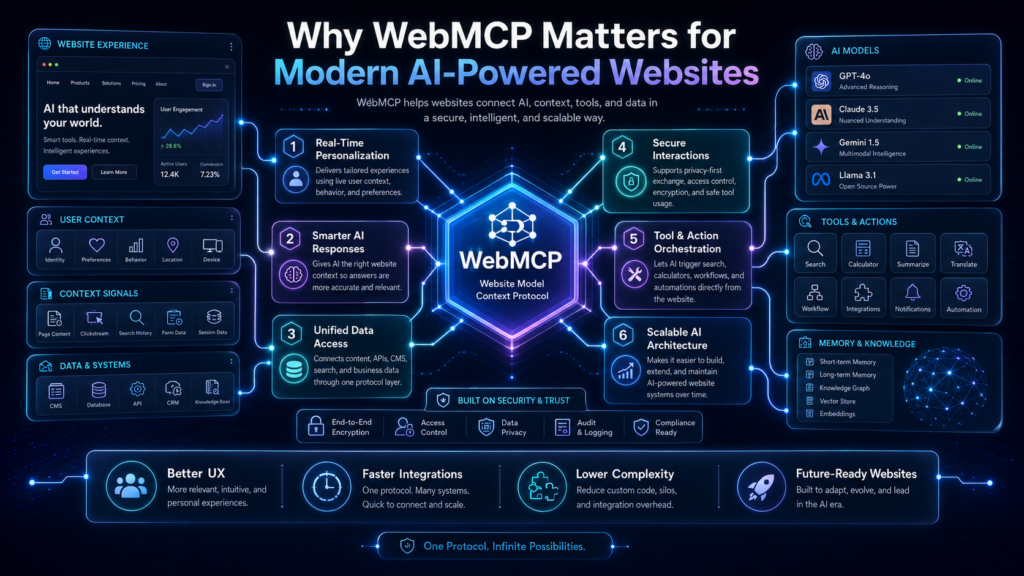
Modern websites are evolving beyond static information platforms into intelligent ecosystems that interact with AI agents, automation tools, enterprise systems, and customer-facing applications. WebMCP provides a standardized framework that allows these systems to communicate efficiently while maintaining context, security, and performance. Businesses seeking long-term AI readiness increasingly rely on WebMCP optimization services to ensure reliable integrations, better search capabilities, and scalable digital infrastructure that supports future innovation and growth.
Why Is WebMCP Important for Businesses and Developers?
As artificial intelligence becomes a central part of business operations, organizations need reliable methods for connecting AI models with websites, databases, and software applications. Understanding what is WebMCP helps businesses unlock intelligent automation while reducing integration complexity. Developers benefit from standardized communication methods that simplify deployment, maintenance, and scalability. Instead of building separate integrations for every AI application, WebMCP creates a structured ecosystem where systems exchange information efficiently. This improves productivity, reduces development costs, and enables organizations to build AI-ready infrastructures that adapt to changing business requirements. Companies investing early in WebMCP integration gain competitive advantages through faster innovation and stronger operational efficiency.
How WebMCP Allows Websites to Integrate with the Model Context Protocol
WebMCP integration establishes a communication layer between websites and AI systems. This layer enables AI agents to access relevant resources, retrieve information, execute predefined actions, and maintain contextual understanding across multiple interactions. Websites equipped with WebMCP can expose structured resources that AI applications understand and utilize effectively. This creates a consistent environment where data remains accessible without complex custom coding for each AI platform. Through proper implementation, businesses can improve content discoverability, streamline workflows, and support intelligent decision-making processes. The result is a flexible architecture that enables continuous growth while supporting future AI technologies and enterprise-scale digital transformation initiatives.
How WebMCP Connects AI Tools, Applications, and Digital Platforms
AI ecosystems often involve multiple technologies operating simultaneously. Businesses may use chatbots, virtual assistants, analytics platforms, CRM systems, internal knowledge bases, and automation tools. WebMCP serves as the bridge connecting these components through a unified communication standard. By providing contextual access to resources and actions, WebMCP allows AI agents to work across platforms without losing consistency. This interconnected approach reduces data silos and improves workflow efficiency. Organizations implementing professional WebMCP solutions can create highly connected digital environments where information flows securely and accurately. These integrations support advanced automation, improved customer experiences, and more effective use of enterprise data assets.
See how WebMCP links digital ecosystems → and transform your online reach with Digital Marketing Services in the USA.
What Is the Google WebMCP Protocol and How Does It Work?
The Google WebMCP Protocol represents a growing focus on standardizing how AI systems discover, access, and utilize web-based resources. It helps establish structured communication methods that enable AI applications to interact with websites more effectively. Organizations exploring webmcp for ai agents often evaluate protocol standards to improve compatibility, search performance, and integration capabilities. Understanding these frameworks is essential for businesses preparing websites and digital systems for the next generation of AI-driven interactions and intelligent automation technologies.
What Is Google WebMCP Protocol?
The Google WebMCP Protocol refers to emerging approaches that support standardized communication between AI systems and web resources. Its purpose is to improve how AI models access information, understand context, and interact with online content. Rather than relying solely on traditional web crawling or static APIs, the protocol promotes structured interactions that deliver more accurate and actionable information. Businesses implementing WebMCP optimization strategies can align their digital assets with evolving AI accessibility standards. This improves discoverability, strengthens AI compatibility, and helps organizations prepare for future search technologies that increasingly rely on intelligent agents and contextual information retrieval mechanisms.
How Does the Google WebMCP Protocol Enable AI Communication?
The protocol enables communication by creating structured pathways between AI systems and web resources. AI applications can discover available resources, understand permissions, retrieve relevant information, and execute authorized actions through predefined communication standards. This approach improves efficiency while maintaining security and governance requirements. By providing clear definitions for resource access and interaction methods, WebMCP reduces ambiguity and enhances interoperability across platforms. Organizations that invest in professional WebMCP implementation can create environments where AI systems interact with business applications reliably and accurately. The result is improved automation, enhanced search capabilities, and better user experiences across digital channels and enterprise systems.
Core Components of a WebMCP Environment
A successful WebMCP deployment depends on multiple interconnected components working together. These elements establish communication pathways, resource access controls, contextual understanding, and integration capabilities. Businesses implementing enterprise WebMCP solutions should understand how each component contributes to system performance, scalability, and reliability. Proper architecture planning ensures seamless communication between AI agents, websites, databases, applications, and external systems while maintaining security, compliance, and operational efficiency across the entire ecosystem.
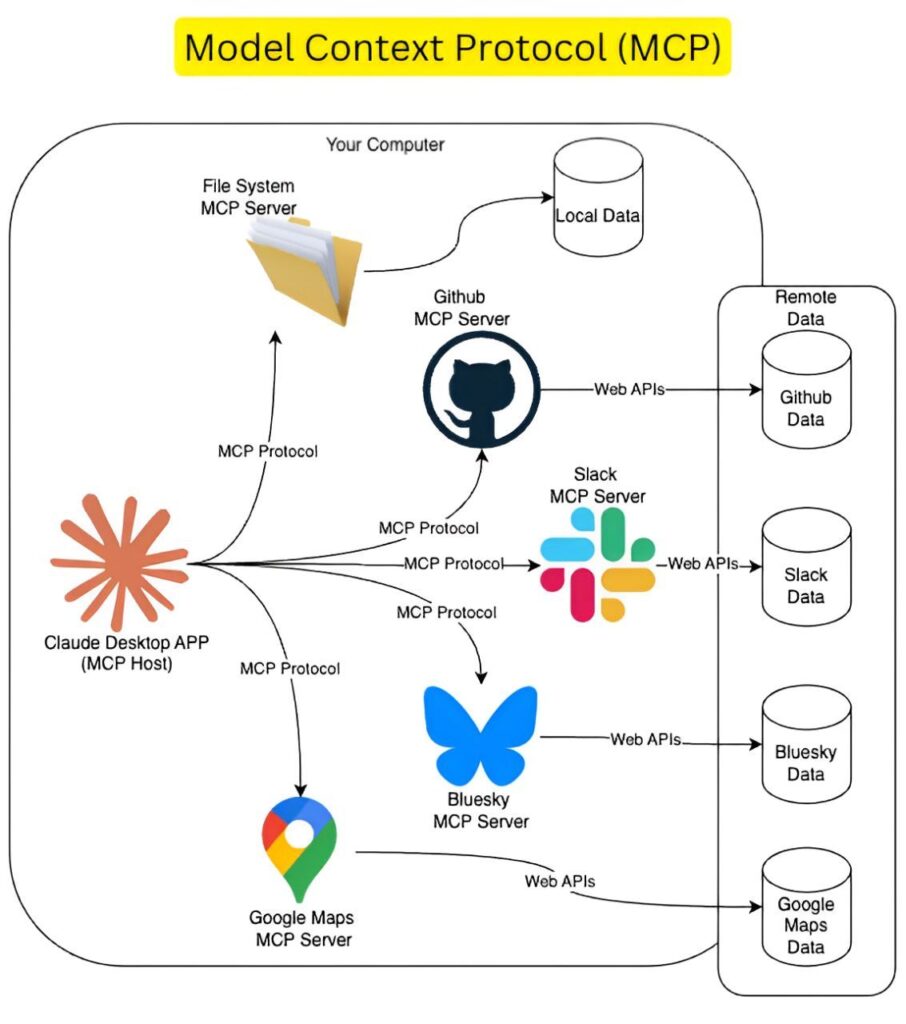
MCP Clients
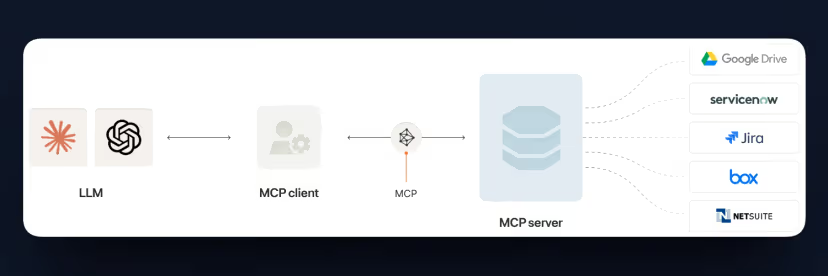
MCP clients act as the requesting entities within a WebMCP environment. These clients may include AI assistants, intelligent agents, business applications, automation platforms, or enterprise software systems. Their primary responsibility is to initiate communication, request resources, and process responses from MCP servers. Effective WebMCP optimization ensures clients receive relevant information quickly and accurately while maintaining contextual continuity. Organizations implementing professional WebMCP development services often focus on client efficiency to improve response times, user experiences, and operational reliability. Well-designed MCP clients help businesses maximize the value of AI integrations while supporting scalable and secure communication across complex digital infrastructures.
MCP Servers
MCP servers function as the central communication hubs within a WebMCP ecosystem. They manage requests, authenticate access, provide resources, and coordinate interactions between AI systems and business applications. Organizations seeking custom WebMCP server development often prioritize performance, scalability, and security to support enterprise workloads. These servers expose structured resources that AI agents can access while maintaining governance controls and operational standards. Effective server implementation improves reliability, supports intelligent automation, and enables seamless integration between websites, databases, and AI platforms. Businesses that optimize their MCP server architecture achieve stronger performance and greater flexibility as technology requirements continue to evolve.
Data Sources and External Systems
Data sources provide the information that AI agents require to perform tasks and generate valuable insights. These sources may include databases, content management systems, customer relationship platforms, document repositories, cloud applications, and external APIs. WebMCP creates a structured framework that enables secure access to these resources while maintaining contextual understanding. Organizations implementing enterprise WebMCP solutions benefit from centralized data accessibility and reduced integration complexity. By connecting diverse systems through standardized communication methods, businesses improve operational efficiency and support more accurate AI-driven decision-making. Proper management of data sources is critical for maintaining performance, compliance, and long-term scalability.
AI Agent Connectivity Layer
The AI Agent Connectivity Layer serves as the bridge between intelligent systems and WebMCP resources. It manages communication protocols, authentication processes, contextual exchanges, and operational workflows. This layer ensures AI agents can access authorized information while maintaining security and compliance requirements. Businesses investing in WebMCP integration services USA often focus on connectivity optimization to improve automation outcomes and system reliability. A well-designed connectivity layer supports efficient resource utilization, accurate responses, and seamless interaction between applications. As organizations expand their AI initiatives, this component becomes increasingly important for maintaining scalable, secure, and high-performing digital ecosystems.
How Does WebMCP Work? A Step-by-Step Breakdown
Understanding how does WebMCP work helps businesses evaluate implementation requirements and identify opportunities for AI-driven growth. The process involves structured communication between clients, servers, resources, and connected systems. Each interaction follows defined protocols that ensure consistency, security, and contextual accuracy. Organizations that understand these workflows can optimize deployments more effectively and create scalable infrastructures that support long-term digital transformation objectives.
Request and Response Flow in WebMCP
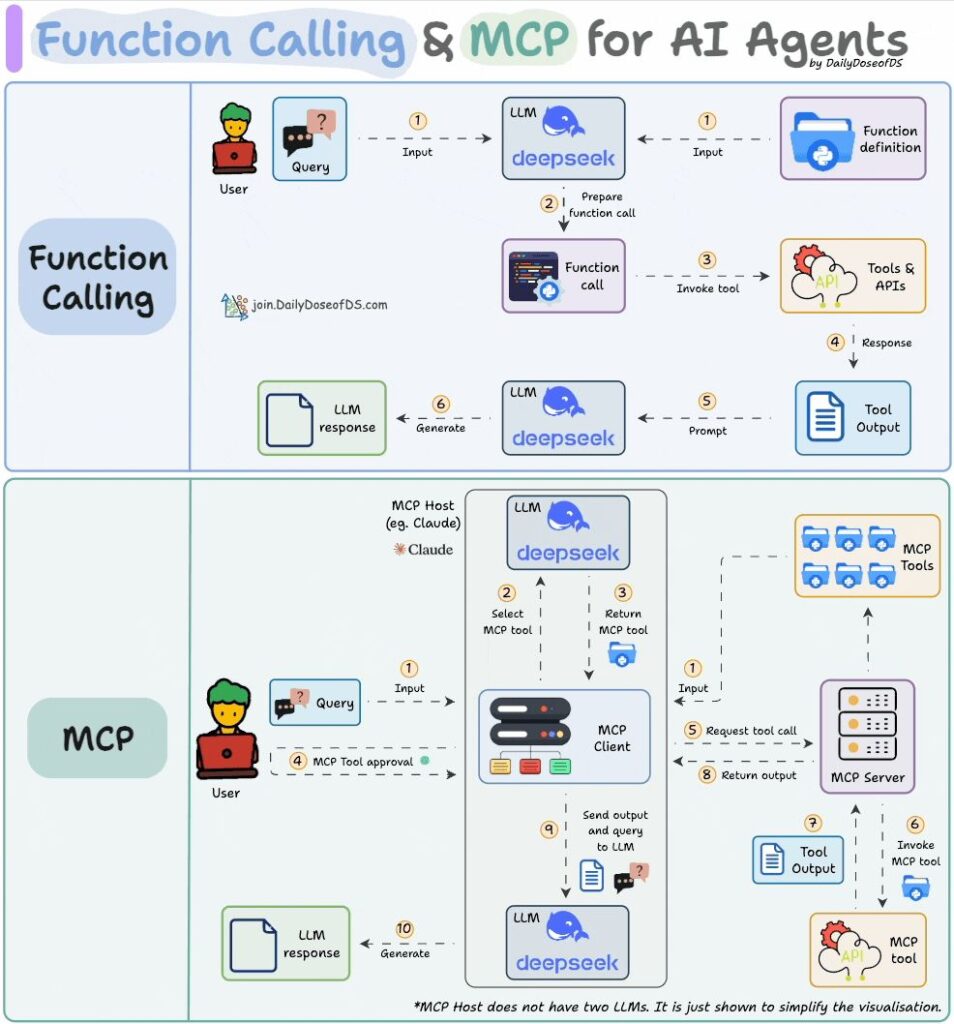
WebMCP operates through a structured request-and-response model. AI agents or applications initiate requests for resources, actions, or information. MCP servers evaluate permissions, process requests, access relevant systems, and generate responses. This controlled workflow ensures consistency and security while maintaining contextual awareness. Businesses implementing WebMCP optimization services often focus on improving response efficiency and reducing latency. Optimized workflows enable faster data retrieval, improved automation performance, and better user experiences. By standardizing communication processes, WebMCP helps organizations build reliable AI ecosystems capable of supporting increasingly complex operational requirements.
How WebMCP Servers Process AI Requests
MCP servers receive requests from authorized clients and evaluate them based on predefined rules, permissions, and contextual requirements. After validation, servers retrieve relevant resources, execute necessary actions, and generate structured responses. These processes occur within controlled environments designed to maintain security and operational reliability. Organizations pursuing enterprise WebMCP deployment solutions prioritize server optimization to ensure consistent performance under varying workloads. Effective request processing improves scalability, reduces operational bottlenecks, and supports advanced AI use cases. By maintaining structured communication workflows, businesses can achieve greater efficiency and more dependable AI-driven operations.
How AI Agents Access Website Resources Through WebMCP
AI agents access website resources through standardized communication channels established by WebMCP. Instead of relying on manual navigation or fragmented integrations, agents interact with structured resources exposed through MCP servers. This allows them to retrieve information, execute actions, and maintain context across multiple interactions. Businesses implementing WebMCP for AI agents gain improved operational efficiency and enhanced automation capabilities. These integrations enable intelligent systems to access relevant content securely while supporting compliance requirements. Proper resource management ensures AI agents can deliver accurate responses, perform tasks effectively, and contribute to meaningful business outcomes.
Real-World Examples of WebMCP Implementations
Organizations across multiple industries are exploring WebMCP implementation to improve automation, search capabilities, and AI integration. Customer support platforms use WebMCP to provide AI agents with access to knowledge bases and service resources. Enterprise organizations connect internal systems to support intelligent workflow automation. Research platforms utilize WebMCP to enhance information retrieval and contextual analysis. E-commerce businesses integrate product databases and customer systems to improve personalized experiences. These examples demonstrate how WebMCP creates practical value by enabling seamless communication between AI technologies and business resources while supporting scalable digital transformation initiatives.
What Is an MCP Server and Why Is It Essential?
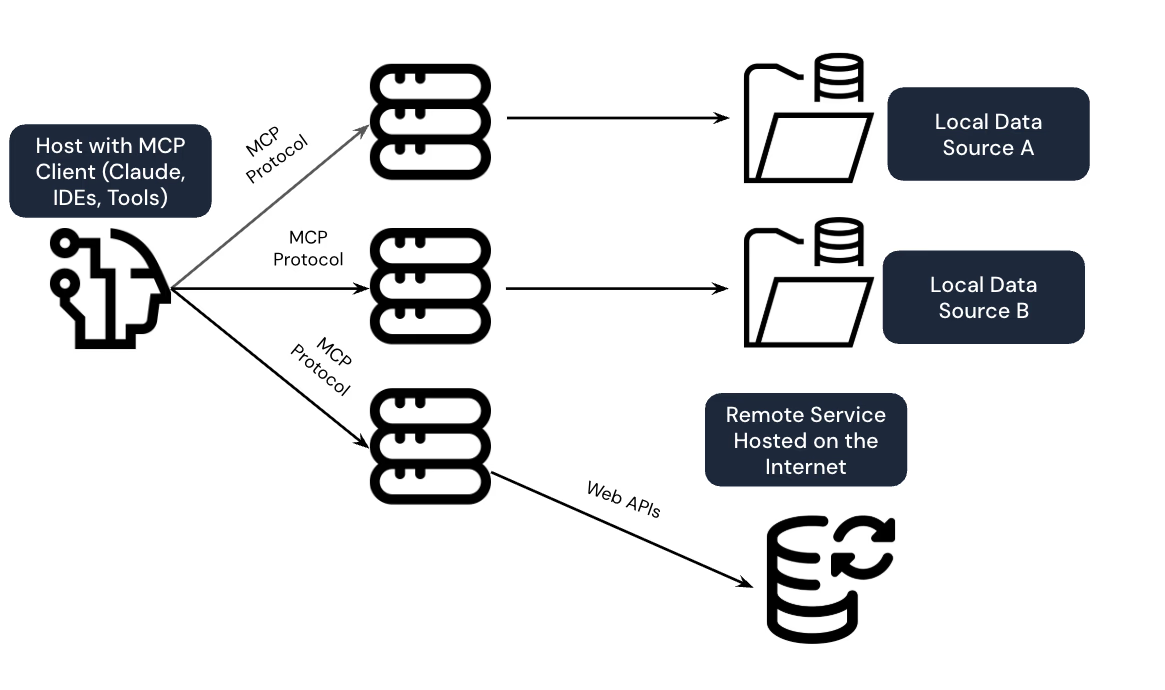
As businesses expand their AI capabilities, they need a reliable infrastructure that enables communication between AI models, websites, applications, and enterprise systems. An MCP server acts as the foundation of a WebMCP environment by managing requests, permissions, resources, and responses. Organizations investing in webmcp optimisation services often begin by deploying robust MCP server architectures that support secure communication, intelligent automation, and scalable AI operations across multiple business systems and digital platforms.
Understanding the Role of an MCP Server
An MCP server serves as the central control point within a Model Context Protocol ecosystem. It receives requests from AI agents, validates permissions, retrieves relevant resources, and delivers structured responses. This process ensures that AI systems interact with authorized data while maintaining consistency and context. Businesses implementing professional WebMCP implementation strategies rely on MCP servers to create a secure and scalable environment for AI communication. Without a properly configured server, organizations may face integration inefficiencies, security vulnerabilities, and operational limitations. MCP servers simplify communication workflows while enabling businesses to support growing AI demands across websites, applications, and enterprise systems efficiently.
How Do WebMCP Servers Work?
WebMCP servers function by exposing resources, tools, and data in a structured format that AI agents can understand. When an AI application submits a request, the server processes it, determines authorization levels, retrieves the requested information, and sends a contextual response. This standardized approach eliminates many challenges associated with traditional integration methods. Organizations utilizing custom WebMCP server development can configure servers to support specific workflows, enterprise requirements, and scalability objectives. Through optimized server architecture, businesses achieve faster processing, better resource management, and enhanced reliability. Properly designed WebMCP servers form the backbone of intelligent digital ecosystems capable of supporting advanced AI-driven operations.
Types of MCP Servers for Different Business Requirements
Different organizations require different MCP server configurations depending on their operational objectives and technical infrastructure. Some businesses deploy internal knowledge servers to support employee productivity and enterprise search functions. Others implement customer-facing servers that enable AI assistants to access product information, support documentation, and service resources. Advanced organizations may use specialized servers for workflow automation, analytics, research, or industry-specific applications. Enterprise WebMCP solutions often combine multiple server types to support complex business processes. Selecting the appropriate server architecture ensures optimal performance, security, and scalability while supporting long-term digital transformation goals and evolving AI requirements.
Common Challenges Businesses Face with MCP Server Deployment
- Insufficient Infrastructure Planning
Many businesses underestimate resource requirements, leading to performance bottlenecks and deployment delays. Proper planning ensures the MCP server can support current and future AI workloads. - Poor Data Organization
Unstructured or inconsistent data makes it difficult for AI agents to retrieve accurate information. A well-organized data architecture improves efficiency and response quality. - Complex System Integrations
Connecting websites, databases, APIs, and business applications can be challenging without a clear integration strategy. WebMCP helps simplify communication between systems. - Security and Access Control Risks
Weak authentication, excessive permissions, and misconfigured security settings can expose sensitive business data. Strong governance and security policies are essential. - Scalability Limitations
As AI usage grows, MCP servers must handle increasing requests and larger datasets. Scalable architecture prevents performance degradation and future migration issues. - Performance Optimization Challenges
Slow response times and inefficient resource management can affect AI performance. Continuous monitoring and optimization help maintain speed and reliability. - Lack of Context Management
AI systems may struggle to maintain accurate context across multiple interactions if MCP resources are not structured properly. Effective context management improves AI accuracy. - Compliance and Regulatory Requirements
Businesses in regulated industries must ensure MCP deployments meet privacy, security, and compliance standards to avoid legal and operational risks. - Monitoring and Maintenance Gaps
Without ongoing monitoring, businesses may miss performance issues, security threats, or integration failures. Proactive maintenance ensures long-term stability. - Difficulty Adapting to Future AI Growth
Many deployments are designed only for current needs. Future-ready MCP architectures allow businesses to expand AI capabilities without major infrastructure changes.
Web Search MCP Servers Explained
Web search capabilities play a critical role in modern AI systems. AI agents require access to accurate, relevant, and contextual information to provide meaningful responses and perform intelligent tasks. Web search MCP servers bridge the gap between search technologies and AI systems by providing structured access to searchable resources. Organizations implementing web search mcp server setup services can significantly improve information retrieval, search accuracy, and AI-driven user experiences across digital platforms.
What Is a Web Search MCP Server?
A web search MCP server is a specialized server designed to provide AI agents with structured access to searchable content and information resources. Unlike traditional search engines that focus on human interaction, these servers are optimized for machine-to-machine communication. They enable AI systems to retrieve contextual information efficiently while maintaining accuracy and relevance. Businesses utilizing web search mcp server setup services can improve content accessibility, enhance search performance, and support intelligent automation initiatives. By integrating search capabilities directly into AI workflows, organizations create more responsive and effective digital experiences for customers, employees, and stakeholders across multiple platforms.
How Web Search MCP Servers Improve AI Search Capabilities
Traditional search systems often provide large volumes of information without contextual prioritization. Web search MCP servers improve this process by delivering structured responses tailored to AI requirements. These servers help AI agents access relevant information faster while maintaining contextual understanding. Organizations investing in WebMCP optimization services benefit from enhanced search performance, improved response quality, and more accurate information retrieval. AI systems can analyze resources more effectively, reducing irrelevant results and increasing efficiency. This capability is particularly valuable for enterprises managing extensive knowledge repositories, customer support resources, and large-scale digital content environments that require intelligent search functionality.
Benefits of Using Web Search MCP Servers for Enterprise Applications
Enterprise organizations depend on accurate information retrieval to support decision-making, customer service, and operational efficiency. Web search MCP servers provide structured access to critical resources while enhancing AI performance. These systems help organizations improve search accuracy, reduce information retrieval delays, strengthen contextual awareness, and deliver superior user experiences. By implementing enterprise-grade search infrastructure, businesses can maximize the value of AI-driven applications while supporting scalability and future growth. The result is a more intelligent digital ecosystem capable of delivering relevant information precisely when it is needed.
Turn MCP Power Into Search Visibility. Get SEO Optimization Services USA
Enhanced AI Search Accuracy
Search accuracy directly impacts the effectiveness of AI applications. Web search MCP servers improve accuracy by providing structured access to trusted resources and contextual information. Instead of relying on fragmented data retrieval methods, AI systems can access organized content that aligns with specific business objectives. This reduces misinformation, improves response relevance, and enhances user satisfaction. Organizations implementing WebMCP optimization strategies often prioritize search accuracy because it influences customer experiences, operational efficiency, and decision-making outcomes. Improved accuracy enables AI agents to provide more valuable insights while supporting business goals and long-term digital transformation initiatives effectively.
AI search just leveled up… and so should you → Discover Google SGE SEO
Faster Data Retrieval
Speed is a critical factor in AI performance. Web search MCP servers streamline information retrieval processes by eliminating unnecessary complexity and reducing processing delays. AI systems can access relevant resources more efficiently, improving response times and workflow productivity. Organizations deploying custom WebMCP server development solutions often optimize retrieval mechanisms to support high-demand environments. Faster access to information benefits customer support operations, enterprise knowledge management systems, and automated business processes. By reducing latency and improving responsiveness, businesses create more effective AI-powered experiences while maximizing operational efficiency and user satisfaction across digital channels.
Improved Context Awareness
Context awareness is essential for intelligent AI interactions. Web search MCP servers help maintain contextual continuity by delivering information that aligns with previous interactions, user intent, and operational objectives. This enables AI agents to provide more meaningful and accurate responses. Businesses implementing WebMCP integration services USA benefit from stronger contextual understanding across customer interactions, internal workflows, and automated processes. Improved context awareness enhances decision-making, increases efficiency, and supports personalized experiences. Organizations that prioritize contextual intelligence gain competitive advantages through more effective AI applications and stronger engagement outcomes.
Better User Experience
User experience remains one of the most important factors in digital success. Web search MCP servers contribute to better experiences by providing accurate information, reducing response delays, and supporting intelligent interactions. AI systems can access relevant resources quickly and deliver more helpful responses to users. Businesses investing in professional WebMCP implementation create environments where customers and employees receive consistent, reliable support. Enhanced experiences improve satisfaction, strengthen trust, and increase engagement. By combining intelligent search capabilities with structured communication frameworks, organizations can create digital ecosystems that meet evolving user expectations while supporting business growth objectives.
How to Set Up a Web Search MCP Server
Successfully deploying a web search MCP server requires strategic planning, technical expertise, and ongoing optimization. Organizations must evaluate infrastructure requirements, configure search endpoints, connect AI tools, conduct performance testing, and implement security controls. Proper setup ensures reliable operations and long-term scalability. Businesses working with WebMCP experts near me or enterprise implementation partners often achieve faster deployment timelines and stronger performance outcomes.
Planning Infrastructure Requirements
Infrastructure planning establishes the foundation for successful MCP server deployment. Organizations must evaluate computing resources, storage capacity, scalability requirements, and anticipated AI workloads. Proper planning helps prevent performance bottlenecks and future expansion challenges. Businesses investing in enterprise WebMCP solutions often conduct detailed assessments to ensure infrastructure aligns with operational objectives. A well-designed environment supports efficient communication, reliable performance, and sustainable growth while minimizing risks associated with underprovisioned systems and unexpected demand increases.
Configuring Search Endpoints
Search endpoints define how AI systems access searchable resources within a WebMCP environment. Proper configuration ensures efficient communication, accurate information retrieval, and secure resource access. Organizations implementing professional WebMCP development services carefully design endpoint structures to support scalability and performance goals. Well-configured endpoints improve system reliability while enabling AI agents to interact with content repositories, databases, and business applications effectively. This contributes to stronger operational outcomes and improved user experiences.
Connecting AI Models and Tools
AI models and tools must be integrated carefully to ensure seamless communication within the WebMCP ecosystem. This process involves establishing authentication mechanisms, configuring resource permissions, and validating connectivity across systems. Businesses implementing WebMCP integration strategies focus on compatibility, performance, and security throughout the connection process. Effective integration enables AI agents to access relevant information, perform tasks efficiently, and maintain contextual awareness across multiple applications and environments.
Testing and Performance Validation
Comprehensive testing ensures that WebMCP deployments operate as expected under real-world conditions. Organizations evaluate response times, resource utilization, scalability, and system reliability before full deployment. Performance validation helps identify bottlenecks and optimization opportunities while reducing operational risks. Businesses investing in best WebMCP optimization services use continuous testing methodologies to maintain consistent performance and support evolving requirements. Effective validation strengthens reliability and improves long-term operational outcomes.
Security and Compliance Best Practices
Security and compliance should be integrated into every stage of WebMCP deployment. Organizations must implement authentication controls, encryption standards, access management policies, and monitoring systems to protect resources and sensitive information. Compliance requirements vary across industries, making customized security strategies essential. Businesses working with professional WebMCP consulting partners can develop governance frameworks that support regulatory obligations while maintaining operational efficiency and system performance.
WebMCP for AI Agents: Unlocking Intelligent Automation
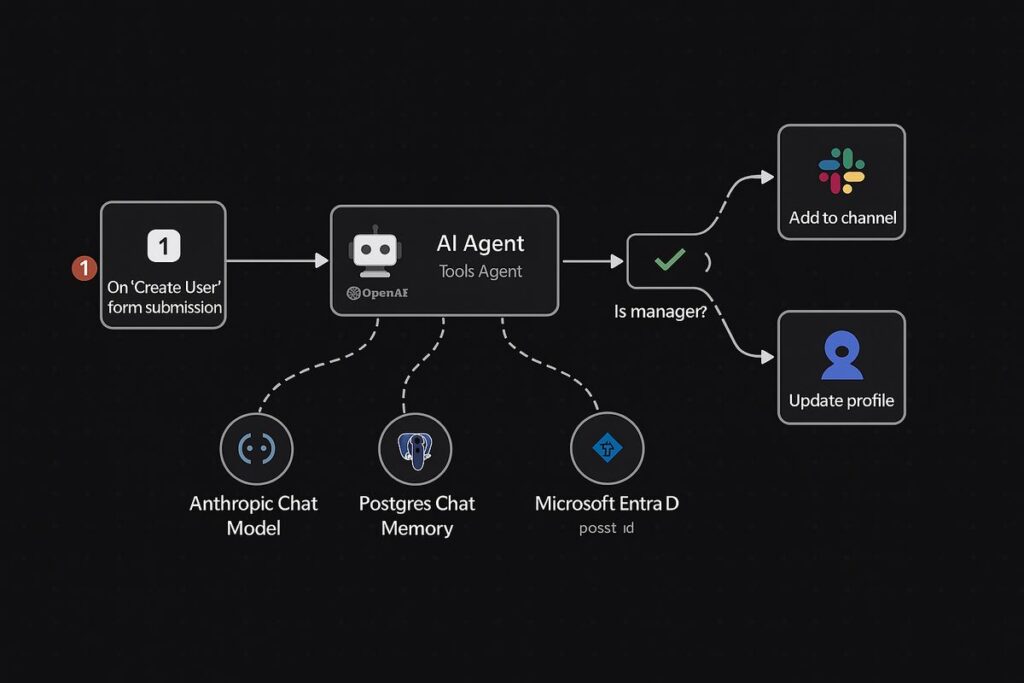
AI agents are becoming increasingly capable of performing complex tasks, analyzing information, and supporting business operations. WebMCP provides the infrastructure necessary for these systems to access resources, maintain context, and interact with enterprise environments effectively. Organizations implementing WebMCP for AI agents gain greater automation capabilities, improved efficiency, and stronger operational intelligence.
What Is WebMCP for AI Agents?
WebMCP for AI agents refers to the use of Model Context Protocol standards to enable intelligent systems to communicate with websites, applications, databases, and business resources. This framework provides structured access to information while maintaining security and contextual continuity. Organizations implementing AI-driven solutions rely on WebMCP to improve agent performance and support advanced automation initiatives. Through standardized communication methods, businesses create environments where AI agents can operate efficiently and deliver measurable value.
How Does WebMCP Help AI Agents Perform Complex Tasks?
AI agents often need access to multiple resources and systems to complete sophisticated tasks. WebMCP simplifies this process by providing structured communication pathways and contextual resource access. Agents can retrieve information, execute workflows, and interact with business applications without requiring custom integrations for every system. This improves efficiency, scalability, and operational consistency. Organizations implementing professional WebMCP implementation strategies benefit from more capable AI systems that support productivity, innovation, and digital transformation objectives.
How AI Agents Use WebMCP to Access Real-Time Information
Real-time information access is essential for many AI-driven applications. WebMCP enables AI agents to retrieve current data from connected resources while maintaining contextual understanding and security controls. This capability supports dynamic decision-making, customer support operations, analytics processes, and workflow automation. Businesses implementing WebMCP integration services can provide AI agents with reliable access to the information required for accurate and timely responses. Enhanced real-time access improves operational performance and user experiences.
AI Agent Use Cases Powered by WebMCP
WebMCP enables a wide range of practical AI applications across industries. Organizations can use the framework to support customer service, knowledge management, research, workflow automation, and operational intelligence. These use cases demonstrate how structured AI communication improves efficiency, accuracy, and scalability while supporting business growth and innovation.
Customer Support Automation
AI-powered support systems use WebMCP to access knowledge bases, service documentation, and customer information. This enables faster issue resolution, more accurate responses, and improved customer experiences. Businesses implementing WebMCP optimization services often achieve significant gains in support efficiency and satisfaction levels.
Enterprise Knowledge Systems
Enterprise knowledge systems rely on WebMCP to connect employees with relevant information resources. AI agents can retrieve documents, policies, procedures, and organizational knowledge quickly and accurately. This improves productivity while reducing time spent searching for information across disconnected systems.
AI Research Assistants
Research assistants use WebMCP to access structured information from multiple sources. These systems support data analysis, content discovery, and knowledge synthesis while maintaining contextual understanding. Organizations benefit from faster research processes and more informed decision-making capabilities.
Workflow and Process Automation
Automation platforms leverage WebMCP to connect AI agents with operational systems and business workflows. This enables task execution, process optimization, and intelligent decision support. Organizations implementing enterprise WebMCP solutions can streamline operations and improve overall efficiency through intelligent automation.
WebMCP Integration: How to Connect Applications, Systems, and AI Platforms
WebMCP integration serves as the foundation for building connected AI ecosystems. By establishing structured communication between applications, systems, and intelligent agents, organizations can create scalable infrastructures that support automation, innovation, and long-term growth. Successful integration requires strategic planning, technical expertise, and ongoing optimization to ensure sustainable performance.
As organizations adopt AI technologies at scale, the ability to connect websites, enterprise systems, cloud platforms, and intelligent agents becomes increasingly important. WebMCP integration provides a standardized framework that enables seamless communication across digital ecosystems.
Businesses implementing webmcp optimisation strategies can reduce integration complexity, improve operational efficiency, and create scalable infrastructures capable of supporting advanced AI initiatives. Effective integration planning ensures systems remain flexible, secure, and prepared for future technological advancements.
What Is WebMCP Integration?
WebMCP integration refers to the process of connecting applications, websites, databases, AI platforms, and enterprise systems through the Model Context Protocol. The objective is to create a unified environment where resources, actions, and contextual information can be shared efficiently. Unlike fragmented integration approaches, WebMCP establishes consistent communication standards that improve interoperability across technologies. Organizations implementing professional WebMCP integration services USA benefit from simplified architecture, stronger automation capabilities, and enhanced AI performance. Through strategic implementation, businesses can eliminate communication barriers between systems while creating scalable ecosystems that support growth, innovation, and long-term digital transformation objectives.
How to Integrate WebMCP into Applications
Successful WebMCP integration begins with understanding business objectives, technical requirements, and system dependencies. Organizations must identify resources that AI agents need to access, establish security policies, configure communication endpoints, and validate system compatibility. Integration teams then develop MCP server environments, connect relevant applications, and test communication workflows. Businesses partnering with a WebMCP development agency often accelerate implementation while reducing deployment risks. Proper integration practices ensure consistent performance, reliable communication, and efficient resource access. Once deployed, organizations can continuously optimize configurations to improve scalability, enhance automation capabilities, and maximize the value of AI-powered operations.
Essential Requirements Before Starting WebMCP Integration
Before beginning WebMCP integration, organizations should establish a strong technical foundation. Key requirements include clearly defined business goals, structured data environments, secure authentication frameworks, scalable infrastructure, and governance policies. Teams must also evaluate existing applications and determine how they will interact with MCP resources. Businesses implementing enterprise WebMCP solutions often conduct comprehensive assessments to identify integration opportunities and potential challenges. Proper preparation reduces implementation complexity while improving deployment success rates. Organizations that invest in strategic planning can achieve smoother integrations, stronger performance outcomes, and greater long-term value from their AI initiatives.
Common Integration Mistakes and How to Avoid Them
Many organizations encounter avoidable challenges during WebMCP deployment due to insufficient planning or technical oversight. Common issues include poor data organization, inadequate security controls, limited scalability planning, and incomplete testing processes. These problems can negatively impact system performance, reliability, and user experiences. Businesses working with professional WebMCP consulting company USA providers can identify potential risks early and implement proven solutions. By following best practices and maintaining a structured implementation approach, organizations can reduce operational disruptions, improve performance, and achieve successful integration outcomes that support future business growth.
Poor Data Structuring
Data serves as the foundation of every WebMCP environment. Poorly structured information can create communication challenges, reduce AI accuracy, and limit automation effectiveness. Businesses must organize content, databases, and resources in ways that support efficient retrieval and contextual understanding. Effective data management improves AI performance while simplifying maintenance and scalability efforts. Organizations implementing custom WebMCP server development often prioritize structured data frameworks to maximize the value of intelligent systems and ensure long-term operational success.
Security Misconfigurations
Security remains one of the most critical aspects of WebMCP integration. Misconfigured authentication settings, excessive permissions, and weak access controls can expose sensitive resources to unnecessary risks. Businesses should implement comprehensive security strategies that include encryption, identity management, monitoring, and regular audits. Organizations utilizing professional WebMCP implementation services benefit from stronger governance frameworks that protect systems while maintaining operational efficiency. A proactive approach to security reduces vulnerabilities and supports compliance requirements.
Scalability Limitations
Many organizations underestimate future growth requirements when designing WebMCP architectures. Systems that perform adequately during initial deployment may struggle as workloads increase. Scalability planning should address infrastructure expansion, resource management, traffic fluctuations, and AI demand growth. Businesses implementing enterprise WebMCP deployment solutions create flexible environments capable of adapting to changing operational needs. Proper scalability planning protects investments and supports sustainable long-term growth.
Incomplete Testing Procedures
Testing plays a vital role in successful WebMCP deployment. Incomplete validation processes can allow performance issues, integration failures, and security vulnerabilities to remain undetected. Organizations should conduct comprehensive testing across functionality, scalability, reliability, and compliance categories. Businesses investing in best WebMCP optimization services often establish ongoing testing frameworks that support continuous improvement. Thorough validation ensures systems operate effectively under real-world conditions and deliver consistent performance.
WebMCP vs Traditional APIs: Which Integration Method Is Better?
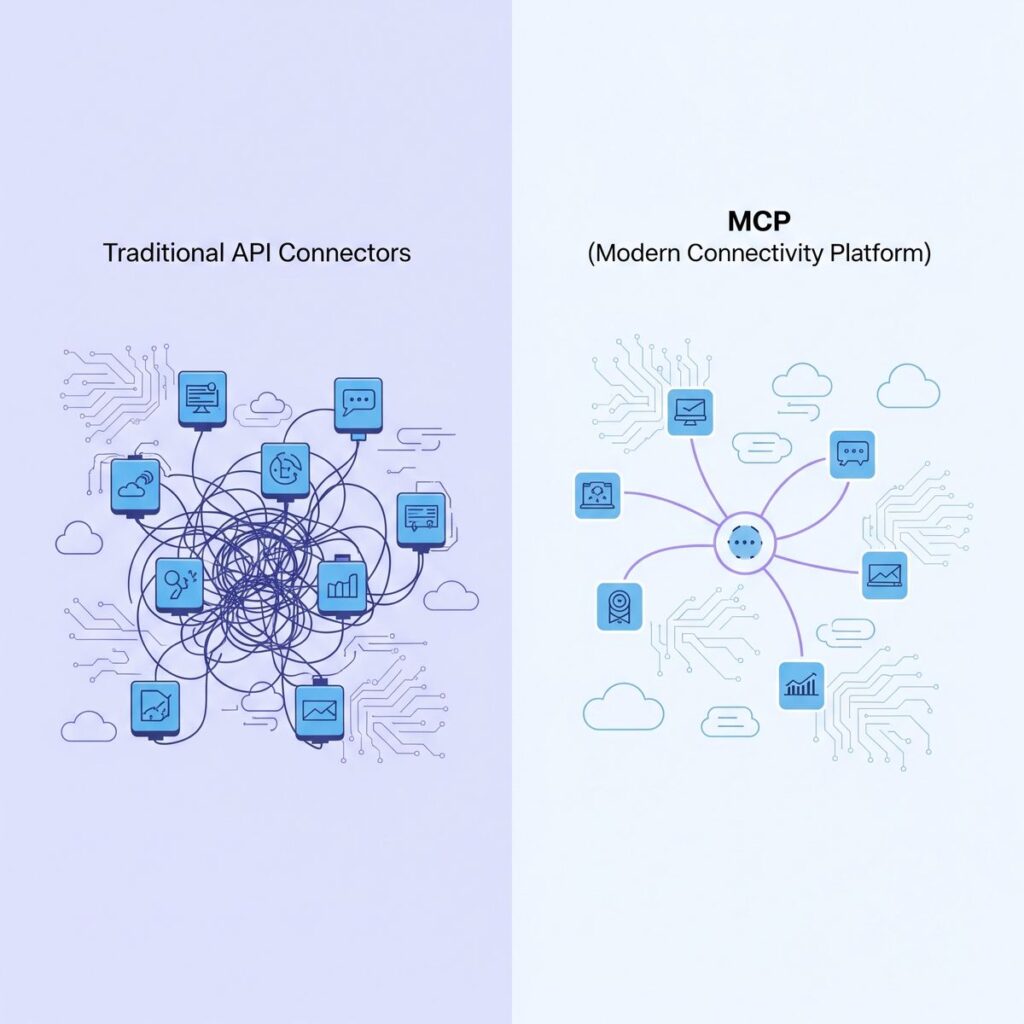
Businesses evaluating AI integration strategies frequently compare WebMCP with traditional APIs. While both approaches facilitate communication between systems, they serve different purposes and offer unique advantages. Understanding the distinction helps organizations choose the most effective solution for their operational goals, scalability requirements, and AI initiatives.
What Is the Difference Between MCP and API?
| Feature | MCP (Model Context Protocol) | Traditional API |
| Primary Purpose | Enables AI agents and LLMs to discover, understand, and interact with resources using context. | Enables applications to exchange data and perform predefined functions. |
| Communication Style | Context-aware and resource-driven communication. | Request-response communication based on fixed endpoints. |
| AI Readiness | Built specifically for AI agents, AI assistants, and LLM integrations. | Originally designed for software-to-software integrations. |
| Resource Discovery | AI can automatically discover available tools, resources, and capabilities. | Developers must manually define and document every endpoint. |
| Context Management | Maintains context across multiple interactions and workflows. | Typically stateless and does not manage conversation context. |
| Flexibility | Highly flexible for dynamic AI environments and intelligent automation. | Limited to predefined functions and workflows. |
| Integration Complexity | Simplifies AI integrations through standardized resource access. | Often requires custom development for each integration. |
| Automation Capabilities | Supports advanced AI-driven workflows and autonomous actions. | Supports automation but usually requires additional development logic. |
| Scalability for AI | Designed to scale with growing AI ecosystems and agent-based systems. | Can become difficult to manage as AI integrations increase. |
| Real-Time Decision Making | Helps AI agents access live resources and make contextual decisions. | Provides data access but lacks built-in contextual intelligence. |
| Developer Effort | Reduces repetitive integration work through standardized communication. | Requires developers to build and maintain multiple custom endpoints. |
| Best Use Case | AI agents, LLM applications, intelligent assistants, enterprise AI automation, and WebMCP environments. | Mobile apps, websites, SaaS integrations, payment gateways, and traditional software systems. |
| Business Value | Improves AI performance, automation efficiency, and future AI readiness. | Provides reliable system connectivity for standard business operations. |
| Future-Proofing | Built to support the next generation of AI-powered ecosystems. | Effective for traditional integrations but less optimized for AI-native environments. |
| Ideal Choice | Best for organizations implementing AI agents, WebMCP integration, and intelligent automation. | Best for applications that require fixed, predictable system-to-system communication. |
| If You Need… | Recommended Solution |
| Standard software integrations | API |
| AI agent connectivity | MCP |
| Context-aware AI interactions | MCP |
| Fixed business workflows | API |
| Intelligent automation | MCP |
| Traditional web and mobile app integrations | API |
| Future-ready AI infrastructure | MCP / WebMCP |
| Enterprise AI ecosystems | MCP / WebMCP |
Is WebMCP Better Than Traditional Integrations?
Whether WebMCP is better than traditional integrations depends on business objectives and technical requirements. For basic system-to-system communication, APIs may provide sufficient functionality. However, organizations implementing AI agents, intelligent automation, and contextual resource access often benefit significantly from WebMCP. The protocol enables dynamic interactions, improved contextual understanding, and scalable AI communication frameworks. Businesses pursuing advanced AI strategies frequently choose WebMCP because it supports long-term innovation while reducing integration complexity. In many cases, the most effective solution combines APIs and WebMCP to maximize flexibility and operational efficiency.
Comparing Scalability, Flexibility, and AI Readiness
Scalability, flexibility, and AI readiness are critical considerations when evaluating integration technologies. Traditional APIs can become difficult to manage as systems grow more complex and AI requirements expand. WebMCP addresses these challenges by providing standardized communication frameworks that support dynamic resource discovery and contextual interactions. Organizations implementing WebMCP optimization services often experience improved scalability and easier integration management. The protocol’s AI-focused architecture makes it particularly well-suited for businesses preparing for future automation and intelligent application requirements. This flexibility enables organizations to adapt more effectively as technology landscapes continue to evolve.
When Should Businesses Choose WebMCP Over APIs?
Businesses should consider WebMCP when they require contextual communication, intelligent automation, AI agent integration, or large-scale digital ecosystems. Organizations managing multiple applications, data sources, and AI systems often find WebMCP more effective than relying exclusively on APIs. The protocol supports richer interactions and simplifies communication across complex environments. Companies investing in professional WebMCP implementation can build future-ready infrastructures that support innovation and scalability. While APIs remain valuable for specific use cases, WebMCP provides a stronger foundation for organizations pursuing advanced AI-driven transformation strategies.

WebMCP Optimization Services: Improving Performance, Security, and Scalability
Deploying WebMCP is only the beginning. To maximize long-term value, organizations must continuously optimize performance, security, reliability, and scalability. WebMCP optimization services help businesses improve operational efficiency while ensuring AI systems perform consistently under evolving demands. Effective optimization strategies support growth, reduce costs, and strengthen digital capabilities across the enterprise.
What Are WebMCP Optimization Services?
WebMCP optimization services focus on enhancing the performance and effectiveness of MCP environments after deployment. These services include infrastructure tuning, resource management, server optimization, security improvements, scalability planning, and monitoring. Organizations utilizing best WebMCP optimization services can improve response times, increase reliability, and support expanding AI workloads. Through continuous analysis and refinement, businesses maintain efficient operations while maximizing the return on their WebMCP investments. Optimization ensures that systems remain aligned with evolving business objectives and technological requirements.
Why Optimization Is Critical for Long-Term Performance
As AI adoption grows, WebMCP environments must handle increasing volumes of requests, data exchanges, and automated workflows. Without ongoing optimization, performance may decline and operational risks may increase. Organizations implementing enterprise WebMCP solutions prioritize optimization to maintain efficiency, support scalability, and improve reliability. Regular performance tuning helps identify bottlenecks, reduce latency, and strengthen system resilience. Businesses that invest in proactive optimization strategies create more sustainable digital infrastructures capable of supporting future innovation and growth.
How to Optimize WebMCP for Maximum Efficiency
Effective optimization requires a comprehensive approach that addresses infrastructure, resource access, query processing, security, and operational monitoring. Organizations should evaluate performance metrics regularly and implement improvements based on changing requirements. Businesses working with professional WebMCP experts near me often achieve better results through customized optimization strategies tailored to specific operational goals. Continuous refinement ensures systems remain responsive, secure, and scalable while delivering maximum value from AI-powered applications.
Server Performance Optimization
Server performance directly influences WebMCP responsiveness and reliability. Optimization efforts include infrastructure scaling, load balancing, caching strategies, and resource allocation improvements. Organizations implementing custom WebMCP server development often prioritize server efficiency to support growing AI workloads. Enhanced performance reduces response times and improves overall system stability. Businesses that optimize server environments can deliver better user experiences while supporting long-term operational growth.
Data Access Optimization
Efficient data access is essential for accurate AI responses and effective automation. Organizations should streamline retrieval processes, improve indexing methods, and eliminate unnecessary complexity within resource structures. Optimized data access reduces latency and enhances operational efficiency. Businesses implementing WebMCP integration services benefit from faster information retrieval and stronger AI performance. Proper resource management ensures systems remain scalable and responsive as data volumes continue to increase.
AI Query Optimization
AI queries must be processed efficiently to deliver accurate and timely responses. Query optimization involves refining request structures, improving contextual processing, and reducing unnecessary computational overhead. Organizations investing in WebMCP optimization services often achieve significant improvements in AI performance through query enhancements. Better query management contributes to faster responses, increased accuracy, and improved user satisfaction. These benefits support stronger business outcomes across AI-driven applications.
Security Hardening Techniques
Security hardening protects WebMCP environments against evolving threats and vulnerabilities. Key practices include multi-factor authentication, encryption, access controls, monitoring systems, and regular security assessments. Organizations implementing enterprise WebMCP deployment solutions should incorporate security improvements into ongoing optimization efforts. Strong security frameworks reduce operational risks while supporting compliance obligations and protecting sensitive business resources.
Monitoring and Continuous Improvements
Continuous monitoring provides visibility into system performance, resource utilization, and operational health. Organizations can identify trends, detect anomalies, and implement proactive improvements before issues impact users. Businesses utilizing professional WebMCP implementation services often establish comprehensive monitoring frameworks that support ongoing optimization. Continuous improvement ensures systems remain aligned with business goals while adapting to evolving technological and operational requirements.
Can WebMCP Improve AI Search Results?
Yes, WebMCP can significantly improve AI search results by providing structured access to relevant resources and maintaining contextual understanding throughout interactions. AI systems operating within optimized WebMCP environments can retrieve information more accurately and efficiently than traditional methods. Organizations implementing web search mcp server solutions often experience improvements in relevance, accuracy, and response quality. Better search outcomes enhance user experiences and increase the effectiveness of AI-powered applications across business environments.
Best Practices for Maintaining an Optimized WebMCP Environment
Maintaining an optimized WebMCP environment requires ongoing attention to performance, security, scalability, and governance. Organizations should conduct regular audits, monitor key metrics, update infrastructure components, review security policies, and refine resource management strategies. Businesses investing in enterprise WebMCP solutions benefit from proactive maintenance approaches that support long-term reliability and growth. Consistent optimization efforts help organizations maximize performance while ensuring AI systems continue delivering measurable business value.

WebMCP Security, Compliance, and Risk Management
As AI systems gain access to business-critical information, security becomes a top priority for every WebMCP deployment. Organizations must ensure that communication between AI agents, websites, databases, and enterprise applications remains protected against unauthorized access, data breaches, and compliance risks. Effective webmcp optimisation includes strong security controls, governance frameworks, monitoring systems, and regulatory compliance strategies. Businesses that prioritize security from the beginning can confidently scale AI initiatives while protecting sensitive information, maintaining customer trust, and meeting industry requirements.
How Secure Is WebMCP?
WebMCP can be highly secure when implemented using industry best practices and proper governance controls. The protocol itself supports structured communication, controlled resource access, authentication mechanisms, and permission-based interactions. Security effectiveness ultimately depends on how organizations design and manage their environments. Businesses implementing professional WebMCP implementation services typically incorporate encryption, access controls, monitoring tools, and identity management frameworks to strengthen protection. Regular security reviews and optimization efforts further reduce vulnerabilities. When deployed correctly, WebMCP provides a secure foundation for AI-to-system communication while supporting enterprise-scale operations and regulatory compliance objectives.
Security Features Every WebMCP Deployment Should Include
A secure WebMCP environment requires multiple layers of protection working together to defend resources and maintain operational integrity. Essential features include strong authentication protocols, role-based access control, encryption for data in transit and at rest, detailed audit logging, and continuous monitoring capabilities. Organizations utilizing enterprise WebMCP solutions often implement centralized governance frameworks to manage permissions consistently across systems. Security automation tools can further improve protection by identifying anomalies and responding to threats proactively. By integrating these safeguards into deployment strategies, businesses create resilient infrastructures capable of supporting advanced AI applications while minimizing operational and cybersecurity risks.
Data Privacy Considerations for Enterprise Organizations
Data privacy is a critical concern for organizations deploying AI-powered systems. WebMCP environments frequently interact with customer records, internal documents, operational data, and proprietary information. Businesses must ensure that access policies align with privacy regulations and organizational requirements. Professional WebMCP consulting company USA services often help organizations establish governance frameworks that support transparency, accountability, and regulatory compliance. Effective privacy strategies include data classification, access restrictions, encryption standards, and retention policies. Organizations that proactively address privacy considerations strengthen trust among customers, employees, and stakeholders while reducing the likelihood of compliance violations and reputational damage.
Reducing Risks in AI-to-System Communication
AI-to-system communication introduces unique risks related to data access, authorization, context handling, and automation errors. Organizations can reduce these risks through comprehensive governance, validation processes, and security controls. Businesses implementing custom WebMCP server development often incorporate safeguards that verify requests, monitor activity, and limit access based on predefined policies. Regular audits and performance reviews help identify potential vulnerabilities before they impact operations. By maintaining strict oversight and implementing layered security measures, organizations can confidently expand AI capabilities while protecting critical business assets and ensuring reliable operational performance.

Enterprise WebMCP Solutions for Growing Organizations
As businesses scale their operations, they require flexible and reliable infrastructures capable of supporting increasingly complex AI environments. Enterprise WebMCP solutions provide the architecture, governance, and integration capabilities necessary for large-scale deployments. Organizations adopting these solutions can improve automation, enhance collaboration, and create connected ecosystems that support long-term growth and innovation.
Enterprise WebMCP Solutions for Large-Scale AI Infrastructure
Large enterprises often manage extensive networks of applications, databases, cloud services, and business systems. WebMCP provides a standardized framework that enables these resources to communicate effectively with AI platforms and intelligent agents. Enterprise deployments focus on scalability, reliability, and operational efficiency while supporting thousands of interactions across multiple environments. Organizations implementing enterprise WebMCP solutions benefit from centralized management, streamlined integrations, and improved automation capabilities. These advantages allow businesses to expand AI initiatives confidently while maintaining control over performance, security, and governance requirements across their digital ecosystems.
Custom WebMCP Server Development for Unique Business Needs
Every organization has unique operational requirements, workflows, and technology environments. Custom WebMCP server development enables businesses to design solutions tailored specifically to their objectives. Development teams can create specialized resource structures, communication protocols, security controls, and integration frameworks that align with organizational goals. Businesses partnering with a WebMCP development agency often achieve greater flexibility and stronger performance outcomes through customized implementations. Tailored server architectures help organizations address industry-specific challenges while supporting innovation and long-term scalability. This approach ensures WebMCP environments deliver maximum value across complex and evolving operational landscapes.
WebMCP Deployment Solutions for Multi-System Environments
Many organizations operate across multiple platforms, cloud services, databases, and applications. Managing communication between these systems can become increasingly difficult as complexity grows. WebMCP deployment solutions simplify this challenge by establishing standardized communication frameworks that support interoperability and contextual information exchange. Businesses implementing professional WebMCP deployment solutions gain improved visibility, stronger automation capabilities, and more efficient resource management. These deployments reduce integration complexity while supporting scalability and operational resilience. Organizations can connect diverse technologies into cohesive ecosystems that improve productivity and support strategic business objectives.
Professional WebMCP Implementation Strategies
Successful WebMCP implementation requires a structured strategy that aligns technology, business objectives, security requirements, and future scalability. Many organizations focus only on connecting systems, but long-term success depends on creating an environment where AI agents, applications, websites, and enterprise platforms can communicate efficiently and securely. A professional WebMCP implementation strategy includes requirement analysis, architecture planning, data preparation, server deployment, security governance, testing, optimization, and continuous monitoring. By following a well-defined implementation framework, businesses can reduce deployment risks, improve AI performance, and create a scalable foundation for future growth.
One of the most important decisions during WebMCP implementation is selecting the right integration approach. Most modern WebMCP environments are implemented using either an Imperative API approach or a Declarative API approach, depending on business requirements, system complexity, and operational goals.
Implementing WebMCP with an Imperative API Approach
The Imperative API approach focuses on defining explicit instructions that AI agents or applications can execute through WebMCP servers. In this model, developers create specific endpoints, actions, and workflows that tell connected systems exactly what operations to perform. Each action is predefined, controlled, and executed according to business logic established during development.
For example, an AI customer support assistant may use an imperative API to retrieve customer information, create support tickets, update account records, or trigger workflow automation processes. The AI agent sends a request, and the server follows a clearly defined sequence of instructions to complete the task.
This implementation method is ideal for organizations that require strict control, predictable workflows, regulatory compliance, and detailed operational governance. Businesses in finance, healthcare, enterprise software, and regulated industries often prefer imperative implementations because they provide greater visibility into system behavior and reduce the likelihood of unexpected actions.
Benefits of the Imperative API approach include:
- Greater control over business processes
- Predictable and repeatable system behavior
- Easier compliance management
- Enhanced security governance
- Better suitability for complex transactional workflows
- Strong auditability and monitoring capabilities
Organizations choosing this strategy typically prioritize operational consistency, security, and precise execution of business-critical functions.
Implementing WebMCP with a Declarative API Approach
The Declarative API approach focuses on describing resources, capabilities, and desired outcomes rather than specifying every action step by step. Instead of instructing systems exactly how to perform a task, developers define what resources are available and what objectives can be achieved. AI agents then determine the most efficient way to interact with those resources within the rules established by the WebMCP environment.
For example, an AI research assistant connected through a declarative WebMCP implementation may discover available knowledge sources, search documentation repositories, analyze content, and retrieve relevant information without requiring a separate predefined workflow for every request. The AI understands what resources are available and dynamically decides how to use them.
This approach is particularly valuable for organizations building advanced AI ecosystems, intelligent assistants, knowledge management platforms, research tools, and autonomous business applications. Declarative implementations provide greater flexibility and scalability because AI systems can adapt to changing requirements without requiring constant redevelopment.
Benefits of the Declarative API approach include:
- Faster integration and deployment
- Greater flexibility for AI agents
- Improved scalability for complex environments
- Reduced development overhead
- Better support for autonomous workflows
- Enhanced adaptability to evolving business requirements
Businesses adopting AI-driven innovation initiatives often choose declarative implementations because they allow intelligent systems to operate more dynamically while maintaining structured access to organizational resources.
Choosing Between Imperative and Declarative WebMCP Implementation
The right implementation strategy depends on business objectives, compliance requirements, operational complexity, and AI maturity. Organizations requiring strict process control, predefined workflows, and regulatory oversight often benefit from an Imperative API implementation. Businesses focused on intelligent automation, AI-driven decision-making, and flexible resource discovery may achieve greater value through a Declarative API architecture.
In many enterprise environments, the most effective strategy combines both approaches. Critical business operations can use imperative APIs for control and governance, while AI research, knowledge retrieval, and automation workflows leverage declarative APIs for flexibility and scalability. This hybrid implementation model allows organizations to balance security, performance, and innovation while maximizing the benefits of WebMCP technology.
We help businesses evaluate their requirements, design the optimal WebMCP architecture, and implement the right combination of imperative and declarative APIs to ensure secure, scalable, and future-ready AI connectivity. Through strategic planning, professional deployment, and ongoing optimization, we create WebMCP environments that support measurable business growth and long-term digital transformation success.

Industries Benefiting from WebMCP Technology
WebMCP is transforming how organizations connect AI systems with digital resources across numerous industries. By enabling secure, contextual, and scalable communication, the protocol supports a wide range of use cases that improve efficiency, customer experiences, and operational performance. Businesses across sectors are exploring WebMCP adoption as part of broader digital transformation strategies.
What Companies Use WebMCP and Similar MCP Architectures?
Organizations investing in advanced AI initiatives increasingly utilize MCP-inspired architectures to connect intelligent systems with business resources. Technology providers, SaaS platforms, research organizations, enterprise software companies, and digital service providers are among the early adopters. These businesses recognize the importance of standardized communication frameworks for supporting AI scalability and interoperability. While implementation approaches vary, the underlying goal remains consistent: creating environments where AI systems can access information, perform actions, and deliver value efficiently. As adoption grows, more organizations are expected to integrate WebMCP concepts into their digital infrastructures and operational strategies.
SaaS and Technology Platforms
Software-as-a-Service providers rely heavily on integrations, automation, and data accessibility. WebMCP enables SaaS platforms to connect AI agents with customer resources, workflows, analytics systems, and operational tools. This improves automation capabilities while supporting personalized experiences and intelligent decision-making. Technology companies implementing WebMCP optimization services often achieve stronger scalability and more efficient resource management. By enabling seamless communication between systems, WebMCP helps SaaS providers deliver innovative solutions that meet evolving customer expectations and support long-term growth objectives.
Healthcare and Medical Applications
Healthcare organizations manage large volumes of sensitive information and complex operational processes. WebMCP can support secure communication between AI systems, electronic records, research databases, and clinical applications. These integrations help improve information accessibility, administrative efficiency, and decision support capabilities. Organizations implementing enterprise WebMCP solutions within healthcare environments must prioritize compliance, privacy, and governance requirements. Properly deployed systems can enhance operational effectiveness while supporting better patient experiences and more informed clinical decision-making processes.
Financial Services and FinTech
Financial institutions require secure, scalable, and highly reliable communication frameworks. WebMCP supports intelligent automation, customer service enhancements, fraud detection initiatives, and operational efficiency improvements. FinTech organizations can leverage WebMCP integration services to connect AI systems with transactional data, analytics platforms, and customer-facing applications. Strong governance and security controls are essential in these environments to maintain compliance and protect sensitive financial information. Effective implementation enables organizations to deliver innovative services while managing risk and supporting business growth.
E-Commerce and Retail Businesses
Retail organizations depend on efficient information access, personalized customer experiences, and streamlined operations. WebMCP enables AI systems to connect with inventory platforms, product catalogs, customer databases, and support resources. Businesses implementing web search mcp server solutions can improve product discovery and search performance while supporting intelligent recommendations. These capabilities help retailers enhance customer engagement, increase operational efficiency, and drive revenue growth. As digital commerce continues evolving, WebMCP provides a foundation for scalable and intelligent retail experiences.
Education and Training Platforms
Educational institutions and training providers are increasingly adopting AI technologies to improve learning experiences and administrative efficiency. WebMCP enables intelligent systems to access educational content, learning resources, assessment platforms, and student support services. Organizations implementing professional WebMCP implementation strategies can create more personalized and interactive learning environments. These integrations support knowledge discovery, content delivery, and operational automation while enhancing accessibility and learner engagement across educational ecosystems.

Is WebMCP the Future of AI Connectivity?
AI adoption continues accelerating across industries, increasing demand for standardized communication frameworks that support intelligent systems. WebMCP addresses many of the challenges associated with AI integration by enabling contextual communication, scalable architectures, and secure resource access. As organizations seek more efficient ways to connect applications, data sources, and AI platforms, WebMCP is emerging as a foundational technology for future digital ecosystems.
Emerging Trends in AI Integration and MCP Standards
The AI landscape is evolving rapidly as organizations pursue greater automation, interoperability, and intelligence. Emerging trends include agent-based systems, contextual computing, autonomous workflows, and standardized communication protocols. MCP standards align closely with these developments by providing frameworks that support scalable and reliable AI interactions. Businesses investing in WebMCP optimization services position themselves to benefit from future technological advancements while reducing integration complexity. As standards mature, organizations can expect increased compatibility and broader adoption across industries.
The Growing Role of WebMCP in AI Ecosystems
WebMCP is becoming increasingly important as AI systems require access to diverse resources and operational environments. The protocol supports communication between applications, databases, websites, and intelligent agents while maintaining context and security. Organizations implementing enterprise WebMCP solutions gain greater flexibility and scalability as AI initiatives expand. This growing role reflects the need for standardized frameworks capable of supporting sophisticated digital ecosystems and increasingly complex automation requirements.
Future Opportunities for Businesses Adopting WebMCP Early
Early adopters of WebMCP can gain significant competitive advantages through improved automation, stronger AI capabilities, and more efficient operations. Organizations that establish scalable communication frameworks today will be better prepared for future innovations and industry changes. Businesses partnering with a WebMCP development agency can create future-ready infrastructures that support growth and adaptation. As AI technologies continue advancing, organizations with mature WebMCP environments will be positioned to capitalize on new opportunities while maintaining operational agility and technological leadership.

Why Choose GDMS for Development and Integration Services?
Organizations adopting WebMCP need more than technical implementation. They require a strategic partner capable of planning, developing, optimizing, securing, and maintaining AI-ready infrastructures that support long-term growth. GDMS provides complete WebMCP optimization, integration, deployment, and consulting solutions designed to help businesses connect websites, applications, AI agents, and enterprise systems efficiently. Our team focuses on delivering scalable architectures, reliable performance, strong security, and measurable business outcomes. Whether you need custom development, enterprise deployment, AI integration, or ongoing optimization, GDMS provides end-to-end support that helps organizations maximize the value of their WebMCP investments.
Need Custom API Integration in WordPress? Build Your Plugin Now
WebMCP Development Agency Delivering End-to-End Solutions
GDMS is a WebMCP development agency focused on creating complete solutions for businesses seeking AI-ready digital ecosystems. Our services cover architecture design, custom server development, AI integrations, workflow automation, performance optimization, and enterprise deployment. We begin by understanding your business goals and technical requirements before creating a customized implementation strategy. Every project is designed to improve operational efficiency, scalability, and long-term flexibility. Through structured development processes and industry best practices, we help organizations reduce complexity while accelerating AI adoption. Our end-to-end approach ensures businesses receive a comprehensive solution that supports growth, innovation, and future technological requirements.
WebMCP Consulting Company USA for Strategic Guidance
Successful WebMCP adoption begins with a well-defined strategy. GDMS provides consulting services that help organizations evaluate opportunities, identify challenges, and develop implementation roadmaps aligned with business objectives. Our experts analyze existing infrastructure, assess AI readiness, and recommend solutions that maximize performance and return on investment. Businesses seeking a WebMCP consulting company USA partner benefit from our experience in integration planning, architecture design, optimization, and governance development. We focus on helping organizations make informed decisions while reducing implementation risks. Through strategic guidance and technical expertise, GDMS helps businesses build strong foundations for successful AI transformation initiatives.
WebMCP Integration Services USA for Businesses of All Sizes
Every organization has unique integration requirements. GDMS provides WebMCP integration services USA designed to support startups, mid-sized businesses, and large enterprises. Our team connects websites, applications, databases, cloud platforms, and AI systems using scalable and secure communication frameworks. We focus on creating seamless interoperability between technologies while maintaining performance and compliance standards. Businesses benefit from streamlined operations, improved automation capabilities, and enhanced information accessibility. By leveraging proven methodologies and customized integration strategies, GDMS helps organizations create connected ecosystems that support efficiency, innovation, and long-term business growth.
Custom WebMCP Server Development Tailored to Your Requirements
Off-the-shelf solutions do not always meet complex business requirements. GDMS specializes in custom WebMCP server development tailored to specific operational needs and industry challenges. Our developers create specialized server architectures that support unique workflows, resource structures, security requirements, and integration objectives. Customized environments improve flexibility while enabling businesses to maximize AI capabilities. Through strategic planning and technical expertise, we design servers that deliver strong performance, scalability, and reliability. Organizations benefit from solutions built specifically for their goals, ensuring greater efficiency and long-term value from WebMCP investments.
Web Search MCP Server Setup Services for AI-Driven Applications
AI systems depend on efficient information retrieval to deliver meaningful results. GDMS provides web search MCP server setup services that help organizations improve search performance, contextual awareness, and AI accessibility. Our team designs and deploys search infrastructures optimized for machine-to-machine communication, intelligent automation, and enterprise-scale workloads. Businesses gain enhanced search accuracy, faster response times, and better user experiences. By integrating advanced search capabilities into WebMCP environments, we enable organizations to unlock greater value from AI-driven applications and digital services.
Best WebMCP Optimization Services for Performance and Growth
Optimization plays a critical role in maintaining high-performing WebMCP environments. GDMS offers comprehensive optimization services focused on improving infrastructure efficiency, resource utilization, query processing, security, and scalability. Our specialists continuously monitor system performance and implement improvements that support evolving business requirements. Organizations utilizing our WebMCP optimization services benefit from reduced latency, improved reliability, stronger AI performance, and enhanced operational efficiency. Through proactive management and continuous refinement, we help businesses maintain competitive advantages while supporting long-term growth objectives.
Dedicated WebMCP Experts Helping Businesses Scale Faster
Building scalable AI infrastructures requires specialized expertise and practical experience. GDMS provides access to dedicated WebMCP experts who guide organizations through every stage of implementation and optimization. Our professionals understand the complexities of AI integration, enterprise architecture, performance management, and security governance. Businesses benefit from strategic recommendations, technical support, and customized solutions that align with operational goals. By working closely with clients, we help organizations accelerate deployment timelines, reduce implementation risks, and achieve measurable results from their AI initiatives.
Complete WebMCP Deployment Solutions from Planning to Support
Successful deployment extends beyond implementation. GDMS delivers complete WebMCP deployment solutions that include planning, architecture design, development, testing, optimization, monitoring, and ongoing support. Our comprehensive approach ensures that organizations receive fully managed solutions capable of supporting evolving business needs. We focus on creating reliable and scalable environments that maximize operational efficiency while maintaining security and compliance standards. Through continuous support and performance monitoring, we help businesses adapt to changing requirements and achieve sustainable success with WebMCP technologies.

How GDMS Delivers Successful WebMCP Projects
Delivering successful WebMCP projects requires a structured methodology that combines business strategy, technical expertise, and continuous optimization. GDMS follows a proven framework designed to reduce risks, improve efficiency, and ensure long-term project success. Our process focuses on understanding organizational goals, building scalable architectures, implementing secure integrations, and maintaining high-performance environments that support future growth.
Discovery and Technical Assessment
Every project begins with a comprehensive discovery and assessment phase. GDMS evaluates existing infrastructure, business objectives, operational workflows, and technical requirements to identify opportunities and challenges. This analysis helps us develop a tailored implementation strategy that aligns with organizational priorities. By understanding the complete business environment, we can recommend solutions that maximize value while minimizing complexity and deployment risks.
Architecture Planning and Strategy
A strong architecture is essential for long-term success. GDMS develops scalable and secure WebMCP architectures designed to support current requirements and future expansion. Our planning process includes infrastructure design, resource management strategies, integration frameworks, governance policies, and security considerations. Through detailed planning and strategic alignment, we create foundations that support reliable operations and sustainable business growth.
Development and Integration
During development and integration, our team builds and connects the components required for successful WebMCP deployment. This includes server development, application integration, resource configuration, AI connectivity, and workflow automation. Every implementation follows industry best practices and rigorous quality standards. Our focus is on creating efficient, scalable, and secure environments that support business objectives while maximizing operational performance.
Testing, Security Validation, and Optimization
Before deployment, GDMS conducts comprehensive testing and validation procedures to ensure reliability and performance. We evaluate functionality, scalability, security, and compliance requirements while identifying optimization opportunities. This process helps eliminate issues before they impact operations. Businesses benefit from stronger performance, reduced risks, and greater confidence in their WebMCP environments.
Deployment, Monitoring, and Ongoing Support
Once validation is complete, GDMS manages deployment and provides continuous monitoring and support services. We track performance metrics, identify improvement opportunities, and implement updates that maintain efficiency and security. Ongoing support ensures organizations continue achieving value from their WebMCP investments while adapting to changing business and technology requirements.

Difference Between WebMCP and MCP? When to Use Which?
WebMCP and MCP are closely related but serve different purposes. MCP is the broader protocol framework that defines how AI systems communicate with resources, tools, and data sources. WebMCP refers specifically to implementing these capabilities within web-based environments, websites, applications, and online systems. Businesses seeking website integration, AI accessibility, and digital ecosystem connectivity often choose WebMCP. Organizations developing broader AI infrastructures may utilize MCP across multiple environments beyond the web. Understanding the distinction helps businesses select the most appropriate solution based on operational goals and technical requirements.
How Much Does WebMCP Integration Cost?
The cost of WebMCP integration depends on project complexity, infrastructure requirements, customization needs, security considerations, and deployment scope. Smaller implementations involving basic integrations generally require less investment than enterprise-scale deployments connecting multiple systems and AI platforms. Organizations should view WebMCP as a strategic investment that improves efficiency, scalability, and automation capabilities. GDMS provides customized assessments and transparent pricing models to ensure businesses receive solutions aligned with their budgets and objectives while maximizing long-term return on investment.
How Long Does Professional WebMCP Implementation Take?
Implementation timelines vary depending on project size, integration complexity, infrastructure readiness, and business requirements. Smaller deployments may be completed within a few weeks, while enterprise-scale projects often require several months for planning, development, testing, and optimization. GDMS follows a structured implementation process designed to accelerate deployment while maintaining quality and security standards. Our team works closely with clients to establish realistic timelines and ensure projects remain aligned with business goals throughout every phase of execution.
Why Should Businesses Choose GDMS for WebMCP Solutions?
Businesses choose GDMS because we provide complete WebMCP solutions focused on performance, scalability, security, and measurable results. Our expertise covers consulting, development, integration, optimization, deployment, and ongoing support. We create customized strategies that address unique business challenges while preparing organizations for future AI advancements. By combining technical excellence with a results-driven approach, GDMS helps businesses unlock the full potential of WebMCP technologies. Our commitment to quality, innovation, and client success makes us a trusted partner for organizations seeking reliable AI integration and digital transformation solutions.

Ready to Build an AI-Ready Business with GDMS?
The future of digital transformation depends on intelligent connectivity, seamless integrations, and scalable AI infrastructures. WebMCP provides the foundation organizations need to connect websites, applications, enterprise systems, and AI agents through a secure and standardized framework. Whether your goal is improving automation, enhancing AI search capabilities, optimizing business operations, or building enterprise-grade AI ecosystems, GDMS delivers the expertise and solutions required for success.
Our team provides complete WebMCP optimization services, WebMCP integration services USA, custom WebMCP server development, web search MCP server setup services, enterprise deployment solutions, and ongoing support designed to help businesses achieve measurable growth. Contact GDMS today to discuss your requirements, receive a customized implementation strategy, and discover how our WebMCP experts can help your organization build a future-ready digital infrastructure that drives innovation, efficiency, and long-term competitive advantage.
References and Technical Resources for WebMCP, AI Integration, and System Architecture Research
Core MCP & AI Protocol Resources
- https://modelcontextprotocol.io
- https://github.com/modelcontextprotocol
- https://www.youtube.com/watch?v=ql6pY7EN1xg
Anthropic (Tool Use & AI Agents)
- https://www.anthropic.com/news/tool-use
- https://docs.anthropic.com
OpenAI Function Calling / Tools
- https://platform.openai.com/docs/guides/function-calling
Retrieval-Augmented Generation (RAG Research)
- https://arxiv.org/abs/2005.11401
AI Agent Systems & LLM Orchestration Research
- https://arxiv.org/abs/2308.08155
Web / API Integration Foundations
- https://restfulapi.net
- https://graphql.org
General AI + Systems Architecture Reference (Cloud/Integration Concepts)
- https://cloud.google.com/architecture
- https://aws.amazon.com/architecture